






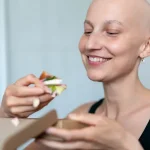

At 42, I was at the peak of my professional and personal life. As a sports nutritionist and training project manager, a graduate of Université Laval, Université de Montréal, HEC, and UQAC, I have supported large organizations and worked at CHU Sainte-Justine with children in trauma care. I know healthcare. I even helped seniors maintain their autonomy by developing nutrition tools. And yet, I didn’t see cancer coming.
The diagnosis
In the fall of 2024, I returned from a four‑month trip through Central America feeling strong and healthy, until digestive pain began to intensify. Doctors spoke of heartburn. Medications were adjusted. I was prescribed a gastroscopy… a year later. On my end, I monitored my symptoms, adapted my diet, and carefully noted every change. Nothing improved.
After weeks of medical uncertainty, everything changed in February 2025. Unable to stand in the subway, severely dehydrated, my heart racing at 156 beats per minute, I was admitted to the hospital as a priority 1 case. A few hours later, the verdict came down: lymphoma. I called my mother, in Saguenay, to come pick me up. I only had the strength to hold the phone.
The system treats the disease… but not everything else
Very quickly, I lost my autonomy. Morphine became necessary, and sometimes a wheelchair was necessary to move around. Swallowing became difficult. Then, a heartbreaking choice had to be made: preserve my fertility or start chemotherapy immediately for my stage 3 diffuse large B-cell lymphoma. On Friday, I faced the ultimatum. On Monday, treatment began.
We think the healthcare system covers everything. It doesn’t. Yes, chemo can treat the disease. But who helps me stand up, literally? Who helps me swallow when the pain is unbearable, manage fatigue and loneliness, and answer my questions when the medical team is overwhelmed? And who helps and takes care of me in daily life? That’s not covered. All of this falls on the patient’s shoulders. And yet, this is what makes the difference between “surviving” treatment and “getting through the ordeal.”
Becoming a manager and partner in your own health
That’s where my professional instincts, autonomy, and self-management skills took over. Searching for information. Asking questions. Taking notes. Preparing for appointments. Validating options. I surrounded and positioned myself as a partner for my own health. I didn’t wait for help to arrive: I looked for it. And that’s where the Quebec Cancer Foundation played an essential role, in giving me access to human, concrete, and accessible resources: those that help you keep your head above water when everything collapses.
“Cancer is not an individual journey, but a path built on essential partnerships.”
I built a team of 12 professionals, including the Foundation’s Info-Cancer Services professionals, who were my lifeline when the medical team was overwhelmed: a massage therapist, an art therapist, a kinesiologist, a nutritionist, a social worker, an acupuncturist, a wig expert, care team members, and a pivot nurse in oncology, and other therapists. Becoming a partner in your health is an act of courage and of kindness toward yourself.
“It takes a village to get through cancer, and for me, the Quebec Cancer Foundation is that village.“
Rebuilding, one day at a time
My last treatment was in July 2025, and I have been under close monitoring since November. Thanks to this network of support, I was able to begin studies in communication at the University of Amsterdam. Today, my mind moves faster than my body: fatigue is heavy, and dryness in my eyes and mouth persists. I’m relearning how to move differently, how to listen to the limits of a body that gave everything. I’m learning to live with a new normal.
Having visited 24 countries — from India, which I dream of seeing again, to Africa, Asia, and South America — I learned to ask for help, to surround myself with people, and to move forward in a different way.
I understood that the medical team is not in charge of everything surrounding my cancer. My role, as a patient and partner, is to identify my needs, ask questions, stay informed, and create my circle of support.
Because the system treats the disease, but the Foundation cares for the person.